There are no items in your cart
Add More
Add More
| Item Details | Price | ||
|---|---|---|---|

AI is changing software careers. Learn future-ready skills now.
An industry-ready engineering program covering Python, machine learning, deep learning, GenAI, agentic AI, quantum computing, Qiskit, PennyLane, hybrid classical-quantum models, portfolio projects, resume building, and mock interviews.
The curriculum starts with coding and data foundations, then moves into ML, deep learning, LLMs, agents, quantum computing and advanced QML capstones.
Python syntax, OOP, NumPy, Pandas, visualization and exploratory data analysis.
Regression, classification, evaluation, feature engineering, PyTorch, CNNs, RNNs and transformers.
LLMs, RAG chatbots, multimodal generation, LangChain tools and agentic workflows.
Qubits, circuits, Qiskit, PennyLane, VQC, QNN, quantum kernels and hybrid models.
These numbers are referenced from government, Stanford, WEF and BLS sources so learners can verify the opportunity themselves. Last reviewed on 11 May 2026.
Government of India approved the IndiaAI Mission to strengthen the national AI ecosystem and compute infrastructure.
Source: PIB IndiaAI MissionPIB reported India’s national AI compute capacity crossed 34,000 GPUs by 30 May 2025.
Source: PIB AI compute updateStanford AI Index 2025 reported India as the second-largest contributor to GitHub AI projects by geographic area in 2024.
Source: Stanford AI Index 2025WEF projects 170 million new roles by 2030, with technology, data and AI among the fastest-growing areas.
Source: WEF Future of Jobs 2025Stanford AI Index 2025 cites 78% of surveyed organizations reporting AI use in 2024, up from 55% in 2023.
Source: Stanford AI Index economyU.S. BLS projects data scientist employment to grow 34% from 2024 to 2034, far above the all-occupations average.
Source: U.S. Bureau of Labor StatisticsReferences are provided for transparency. We do not use fake placement guarantees or unsupported salary promises. Job outcomes depend on learner effort, portfolio quality, interview readiness, location and market conditions.
A clear, honest transformation path for beginners, freshers and working professionals who want to enter AI with practical confidence.
Step-by-step beginner friendly training, built so learners can grow without jumping blindly into advanced AI.
Data Science, AI, Generative AI, prompt engineering, agentic AI, Python programming, AI testing, corporate training and career mentoring.
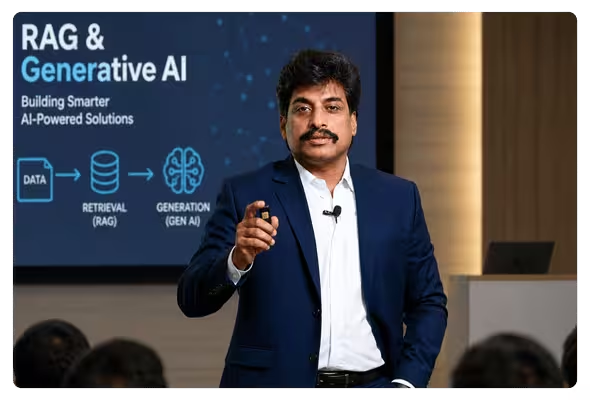
With 25+ years of IT experience and an M.Sc. in Computer Science from Manipal University, Subba Raju Sir focuses on hands-on, industry-oriented learning that bridges academic concepts with real-world applications.
Start with Python basics and grow step by step.
Build practical AI skills alongside your degree.
Create projects and interview-ready proof of skill.
Upgrade into AI, GenAI and automation workflows.
Move toward future-ready software roles with structure.
Each phase is organized from the official Quantum AI Engineering curriculum and includes tools, assignments and implementation outcomes.
Build and deploy intelligent software workflows.
Create LLM, RAG and generative AI applications.
Train, evaluate and package machine learning models.
Use agents and tools to automate real business tasks.
Use Python to build AI apps, APIs and data workflows.
Simple, practical projects that help you explain your skills in interviews.
Build a conversational AI app for practical user questions.
Use documents, embeddings and retrieval to answer with context.
Create a tool-using agent that can plan and complete tasks.
Compare QML models with classical machine learning baselines.
Build an AI tool that reviews resumes and suggests improvements.
The curriculum highlights resume building, real-time mock interviews, 1:1 career mentorship and industry-ready positioning.
Turn projects into strong resume bullets with role-ready language for AI and QML openings.
Practice technical explanations, project walkthroughs and HR interview responses.
Get direction on learning gaps, portfolio polish, interview strategy and career path selection.
"Subba Raju sir explains even complex concepts with great clarity. The hands-on projects with modern tools and generative AI boosted my confidence and real-world skills."
Janumpally Anilkumar"The course is well-structured and industry-focused, covering everything from core testing to advanced automation with Generative AI in a simple, practical way."
Manoj Kumar"I joined with zero technical background, but now I can confidently work with tools and use generative AI to automate processes."
U. Lm Yadav"We did not just learn concepts. We worked on real-time automation projects that are highly relevant in today's industry."
Vamshi VinnieClear answers about syllabus, eligibility, projects, tools, career outcomes and learning support.
Yes. It starts with Python basics, data structures, OOP, NumPy, Pandas, visualization and maths before moving into ML, GenAI, quantum computing and QML.
Beginners, B.Tech students, freshers, working professionals and career switchers can join if they are ready to learn step by step and practice consistently.
No advanced coding background is required. The course begins with Python fundamentals and gradually moves into AI, GenAI, agents and Quantum AI concepts.
Quantum AI Engineering combines classical AI skills such as Python, machine learning, deep learning and GenAI with quantum computing concepts such as qubits, gates, circuits and Quantum Machine Learning.
The roadmap is Python, Machine Learning, Deep Learning, GenAI, AI Agents and Quantum AI. This helps learners move from fundamentals to advanced topics in a structured order.
Python, VS Code, Jupyter Notebook, NumPy, Pandas, Matplotlib, Seaborn, Plotly, scikit-learn, XGBoost, PyTorch, Hugging Face, LangChain, OpenAI API, FAISS, FastAPI, Docker, Qiskit, IBM Quantum, PennyLane, GitHub and LinkedIn.
Yes. The GenAI part covers LLMs, prompt engineering, embeddings, vector stores, RAG workflows, chatbots and practical application building.
Yes. Learners are introduced to agentic workflows, tool usage, planning loops and practical AI automation use cases using modern AI development patterns.
Yes. The final phases cover data encoding, parameterized quantum circuits, variational classifiers, quantum neural networks, quantum kernels, hybrid models, noise and real hardware practice.
Yes. Assignments run across every phase, and the capstone section requires GitHub code, reports, video walkthroughs and research-style reproduction work.
Project examples include an AI chatbot, RAG app, AI agent, Quantum ML experiment, resume analyzer, ML model comparison and hybrid classical-quantum model.
Yes. B.Tech students can use this course to build practical AI projects, strengthen GitHub, prepare for internships and improve their understanding of modern AI tools.
Yes. Freshers can use the course to build a project portfolio, understand interview topics and develop practical confidence in Python, ML, GenAI and AI tools.
Yes. Working professionals can use it to upskill into AI, GenAI, automation and emerging Quantum AI concepts while connecting learning to real projects.
Possible target roles include AI Engineer, GenAI Developer, ML Engineer, AI Automation Engineer and Python AI Developer. Outcomes depend on effort, portfolio quality and interview readiness.
The official curriculum includes resume building, real-time mock interviews, 1:1 career mentorship, HR prep, technical Q&A and placement support.
Yes. The course starts with Python syntax, variables, control flow, functions, data structures, OOP and file handling before moving to data and AI libraries.
Yes. The syllabus includes supervised learning, classification, regression, feature engineering, model evaluation, PyTorch, CNNs, RNNs, attention and transformers.
Yes. RAG concepts are included through embeddings, vector stores, document retrieval and chatbot-style applications that answer from context.
Yes. Quantum computing and Quantum ML sections include tools such as Qiskit, IBM Quantum and PennyLane for circuits, models and hybrid workflows.
Certification details may depend on the active batch and academy policy. Please confirm current certificate terms with the GenAI Training Academy team before enrolling.
Most AI courses stop at Python, ML or GenAI. This program connects Python, ML, deep learning, GenAI, AI agents and Quantum AI into one structured engineering path.
Yes. Career switchers can join because the course starts from foundations and adds practical projects, resume direction and interview preparation.
Use the enroll button on this page or contact the team at care@genaitraining.academy for current batch details, seat availability and enrollment guidance.
Learn AI + GenAI + Quantum AI with real projects. Actual price ₹34,999/-; comparable market programs can cost ₹75,000 + GST or more.